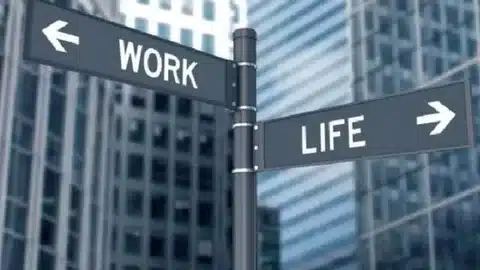
For years, the conversation was about balance. Work on one side, life on the other, and the hope of keeping both from crashing into each other. The phrase “work-life balance” became so overused that it started to feel like a cliché. But if you pay attention to how younger people live today, you’ll notice something entirely different. They aren’t striving for balance anymore. They’re blurring the lines. Work is no longer just what they do; it has seeped into who they are. It’s not balance they want; it’s integration. And this subtle but radical shift is reshaping everything from how friendships are formed to how apartments are designed.
The old way was compartmentalised. You had an office you went to, a home you returned to, and friends you saw after hours. The two worlds were meant to stay distinct. A bad day at work was something you left at the office door. But in an age where people introduce themselves as creators, strategists, or founders even in casual settings, identity and occupation have fused in ways that previous generations might have found unimaginable. The question “What do you do?” isn’t just a polite icebreaker anymore; it’s shorthand for values, ambitions, and sometimes even aesthetics.
This blurring isn’t just professional; it’s deeply personal. Friendships are being forged around projects instead of pastimes. Dating often feels like a merger between personal attraction and brand alignment. Even the spaces people live in are designed to double as workplaces, studios, and performance stages. What was once a clear divide is now an intricate tapestry. To understand the lives of younger generations, you need to see how this blur is reshaping the way they love, live, and design their everyday worlds.
Friendship used to be about the people you grew up with, the ones who lived nearby, or those you stumbled across in social settings. Today, more and more friendships are incubated around work-adjacent spaces. A weekend hangout might be a brainstorming session. A group chat might start with memes but inevitably circle back to project deadlines or someone’s startup idea. There’s no longer a neat divide between a friend and a colleague.
Take the story of two women who start a podcast together. At first, they’re just friends catching up. But the moment they buy microphones and create a schedule, their friendship transforms into a partnership. Suddenly, the line between companionship and collaboration is blurred. Their shared bond is inseparable from their shared work. This is happening everywhere, with creatives, freelancers, entrepreneurs, even professionals in more traditional roles who find themselves using their friendships as networks of exchange.
There’s something beautiful in this. Friendships take on a new depth when they’re tied to shared ambition. People find belonging not only in laughter but in creating something together. But there’s also a fragility in it. When the project falls apart, sometimes so does the friendship. What was once an unshakeable bond becomes entangled in disagreements about commitment, vision, or output. The risk of losing both a collaborator and a friend is a unique kind of heartbreak this generation knows well.
Dating has also transformed. Love is still love, but the conditions around it have changed. The fusion of work and identity has made dating strangely practical. People want partners whose ambitions don’t just match but complement their own. A graphic designer might fall for a photographer because they can already envision the joint projects. A startup founder might seek another entrepreneur because who else would understand the chaos of late-night strategy calls?
This isn’t to say romance has disappeared. On the contrary, shared ambition can be intoxicating. But it can also turn dating into something transactional. When everyone is a brand, relationships risk becoming collaborations with a romantic veneer. Breakups in this context aren’t just about hearts breaking; they’re about shared projects dying, about deciding who gets custody of the podcast, the audience, the creative momentum.
Still, there’s something profoundly modern about couples who are both lovers and co-creators. Their intimacy is built on a shared vision, and their bond is strengthened by every success they achieve together. The danger lies only in forgetting that love deserves a space separate from work; a space where being human matters more than being productive.
Walk into the apartment of a young professional today and you’ll notice a particular aesthetic. There’s likely a desk pushed up against a window for natural Zoom light, a ring light tucked away in the corner, and a wall curated with plants or artwork that doubles as a perfect backdrop. The home is no longer just private. It’s a set, a studio, a brand statement.
Apartments have become multifunctional; they’re offices during the day, content studios in the afternoon, and social hubs in the evening. The design choices are made not just for comfort but for performance. Even minimalism itself has become part of a lifestyle aesthetic, a choice that says as much about the resident as any job title could.
This is especially true in cities where space is limited and expensive. Instead of having separate environments for work and leisure, people create modular spaces that can transform with the day’s needs. A kitchen counter doubles as a desk. A couch is both for relaxing and for client calls. The very architecture of home is adapting to the work-life blur.
But this has psychological consequences. When your home is your office, your studio, and your social space, when does the mind get to rest? Some people find comfort in the seamlessness, in living a life where every corner of their apartment affirms their identity. Others feel suffocated, unable to find refuge from the constant hum of work.The beauty of the blur is undeniable. Work is no longer a soulless grind for many young people; it is a mirror of selfhood. To be a writer, a designer, an entrepreneur, or a strategist is not just to earn a living but to inhabit an identity that feels true. Friendships become laboratories of creativity, relationships become engines of ambition, and homes become testaments to possibility. The blur can feel like freedom: the freedom to live a life where you never have to pretend to be one thing at work and another at home.
Nevertheless, with that beauty comes tension. Burnout wears the mask of passion. Every relationship feels like a negotiation of roles and goals. Every friendship carries the weight of shared expectations. Every home is invaded by invisible eyes — the imagined audience of social media, colleagues, or clients.
And so, the challenge is not to run from the blur but to navigate it. To ask: how do we keep a piece of ourselves that is untouched by work? How do we preserve the intimacy of friendship and love without reducing it to collaboration? How do we make our homes sacred again, even while they double as stages? These questions haunt the edges of this new world, waiting for answers that are still being written.
Perhaps this blur is not a trend but the natural outcome of living in a world where technology collapses boundaries and where selfhood has become performative. Maybe it is less about balance or burnout than about the evolution of identity itself. For older generations, work was what you did to earn your life. For this one, work is how you live your life. It is a canvas, a stage, a vehicle of expression.
Whether this is sustainable or not is another question. But it is undeniably here. And maybe the real goal is neither to fight the blur nor to surrender to it, but to craft a life where blur doesn’t mean erasure, where being fully yourself does not mean being fully consumed by work.
In the end, identity is not a résumé, nor a profile, nor a curated home office. It is the quiet, unbranded self who sits at the edge of the bed when the camera is off, the self who knows that being human has always been bigger than being productive.
Stay frosty.




Great, good job 👍
Thanks ore mi
This is quite an interesting read. Thanks for sharing.
You’re welcome 🙏🏾