What’s the worst that could happen when you willingly accept to cover for a sick colleague?
You’ll lose a bit of rest definitely. Maybe you’ll deal with cranky coworkers but surely nothing life-altering, right?
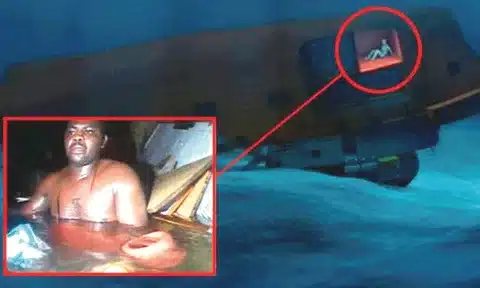
That small, harmless decision was what put Harrison Okene on board the Jascon-4 on the morning of May 26, 2013. He was there as a cook, covering for another man who had fallen ill. The tugboat owned by a company called West African Ventures had been chartered to steady a massive oil tanker off the Nigerian coast.
But that day, things went from routine to unbelievable.
A storm had rolled in before dawn, tossing the vessel like a toy in the angry Atlantic. Somewhere between the waves and the wind, the Jascon-4 flipped upside down and plunged to the bottom of the sea, over 100 feet below.
One moment Harrison was getting ready for breakfast duty, and the next, he was trapped in freezing, pitch-black water, gasping for breath and holding on to hope as everything he knew collapsed around him. Alone. Disoriented. Counting each breath like it might be his last.
This is the incredible story of the man who lived underwater for more than 72 hours.
The Morning Everything Changed
Harrison Okene was 29, a soft-spoken man who loved his job and the people he worked with. He wasn’t a diver or an engineer, just the ship’s cook, responsible for keeping the crew fed and happy.
That morning, he woke up around 5 a.m., the way he always did. The sea was restless, so the boat rocked from side to side as rain pelted the metal deck. Still half-asleep and half-dressed, he steadied himself against the wall and began his morning prayer, something he never skipped. After that, he made his way to the galley to warm up the hot plates for breakfast.
Then, he went to the bathroom to freshen up. Four crew members were already there brushing their teeth, so he waited and decided to use the toilet instead. It was a tiny, routine decision, the kind that unknowingly saves or changes lives.
While Harrison went about his morning, the other crew members were focused on the tugboat’s task of keeping the massive tanker stable as it transferred fuel from a nearby oil platform. The operation was part of Nigeria’s booming offshore oil business. The work came with long hours and heavy risk.
Harrison, three days away from his leave, had done this so many times that he barely noticed the danger anymore. He even glanced out a porthole and, for a fleeting moment, thought, What if this boat flipped?
He dismissed the thought as quickly as it came. Still, fate has a strange way of answering the questions we don’t mean to ask.
Without warning, a giant wave struck the Jascon-4. A thunderous sound ripped through the hull, followed by chaos. The entire vessel lurched violently, and then everything went black.
Harrison was thrown across the small bathroom. The toilet tore loose from its mount and slammed into his head, cutting into his scalp. In an instant the world he knew was inverted: ceilings became floors, the lights died, and cold, black water rushed through the hull. The boat had capsized.
Water was rushing in fast, swallowing rooms, hallways, and voices. He stumbled toward the door, trying to open it, but the pressure on the other side made it nearly impossible. He finally forced it open, and what greeted him was pure terror: darkness, floating debris, and men shouting for help.
Somewhere nearby, he saw a faint light, the glow of a crew member’s phone, and swam toward it. Three other men were struggling at the exit hatch, trying to force it open. He joined them, but as the water surged, panic overtook him. He turned away, swimming back into the passageway against every human instinct.
That decision saved his life.
Moments later, a powerful rush of water swept through the corridor, taking the men by the hatch with it. Harrison was thrown into another room, the second engineer’s cabin, and the door slammed shut behind him. He was alive, but trapped.
As the tugboat continued its descent, the noise of screaming and banging faded until there was only the sound of creaking metal and the rhythmic thud of his own heartbeat.
The cabin was filling with water but not completely. Because the doors had been shut to protect against pirates, a small bubble of air was trapped inside the room. That air pocket was the only thing standing between Harrison and death.
He positioned himself in that small space, his head tilted back, breathing shallowly to conserve oxygen. His mind was spinning. The temperature had dropped. The water was icy. He had no light, no food, and no clue if anyone even knew the ship had sunk.
Every few minutes, another noise echoed through the wreck: shifting metal, collapsing walls, or, worst of all, silence. He tried to push open the door, but the pressure was too strong. In his panic, he broke off the handle. Exhausted, he forced himself to calm down. He prayed. Then he started thinking.
He found a vent pipe, broke it, and used it to pry open a connecting door into the second engineer’s main cabin. Inside, he found two life jackets — both soaked in diesel. He pulled off their lights, stuffed one into his mouth and the other into his boxers, and tried swimming toward the exit hatch again.
The passageway outside was completely submerged. There were no air pockets. Each time he tried, he had to fight his way back before running out of breath.
He tore up overalls to make a rope, tying one end to the cabin door so he could find his way back. Each time he tried, he failed. By then, he had realised the other crew members were gone. Their shouts had long faded into the cold.
Surviving in the Dark
He built himself a small raft from wooden ceiling panels to stay above the rising water. In the blackness, he could hear the scratching sounds of sea creatures feeding on the dead. Crayfishes were feasting on his own skin.
In the darkness, he found a can of sardines and one bottle of Coke. He rationed them, taking tiny bites, sipping just enough to wet his throat. His lips were cracked, his body cold, and his mind flickered between faith and despair.
Hours melted into each other until Day 1 slipped into Day 2, though Harrison couldn’t tell. Time didn’t exist at the seabed; there was only darkness, silence, and the sound of his own breathing.
The air inside the pocket was stale and heavy with carbon dioxide. His flashlight batteries had died. Everything was still, except for the slow creaking of metal.
It had been three days since the Jascon-4 disappeared. He prayed harder. He sang hymns he could barely remember.
“I called on God,” he would later say. “He gave me hope. He made me calm.” And then, finally — a sound.
The Light in the Dark
Harrison heard a faint noise, the distant hum of engines and movement in the water. Then, a splash. Then another.
At first, he thought he was hallucinating. But when he saw a flicker of light reflecting off the walls, he knew something or someone was there. He took a deep breath and swam toward it.
The light grew closer, then vanished. He went back to his air pocket, panting. A few minutes later, bubbles rose from the same direction. Gathering what little strength he had left, he tried again, this time pushing forward until he saw the outline of a human figure. A diver.
He reached out and touched the man’s shoulder. The diver froze and then tried to swim away. Everyone aboard the Jascon 4 was presumed dead, and their grim mission was recovery not rescue. So when South African diver Nico van Heerden felt a hand suddenly grab his shoulder, his blood ran cold. Bodies don’t move. Bodies don’t reach out. For a split second, he thought he was in danger, until that cold hand squeezed his. That’s when it hit him: this one was alive.
“I’m alive”, Harrison tried to say, but all that came out were bubbles.
Nico turned, and for a second, their eyes met through the mask. The shock was visible even underwater. Nico had just found a man, alive 30 meters deep, three days after the boat had sunk.
He led Harrison back to the air pocket. Other divers joined them, including the life support supervisor Colby Koch and dive operations manager Tony Walker, who quickly switched from recovery mode to rescue mode.
They gave him water, fitted him with an oxygen mask, and carefully explained what would happen next. He couldn’t just be rushed to the surface, his body had absorbed too much nitrogen from being underwater for so long. A rapid ascent could kill him instantly.
So, they brought down a diving bell, a sealed capsule and slowly lifted him up, controlling the pressure every step of the way.
Back to the Surface
When Harrison finally reached the surface, he hadn’t seen sunlight in 72 hours. His first breath of open air felt unreal like being born again.
He was taken straight to a decompression chamber, where he spent another three days under medical supervision. Doctors expected to find a wrecked body but to their surprise, his vitals were almost perfect.
The world later called it a miracle. Scientists called it an anomaly.
Out of the twelve men who had been on board the Jascon-4, Harrison was the only one who made it out alive. When he learned the fate of his crewmates, the weight of it hit hard. These weren’t just colleagues, they were friends he’d laughed and worked with, men he’d shared meals and stories with. He’d even made plans to visit one of them during his upcoming leave. Now, all he could do was mourn them.
Back home, Harrison Okene struggled with nightmares. He’d wake up drenched in sweat, hearing the sounds of water rushing in, feeling the darkness closing around him again. He eventually sought medical help, and to their credit, the company offered him all the support he needed.
Then, a year after the Jascon-4 sank, life tested him once more. Harrison was driving to work in Port Harcourt with a friend when his car suddenly went off a bridge and plunged straight into the water. Just like that. But this time, instead of panic, something inside him stayed calm. He pulled himself out, went back for his friend, and even helped recover the car from the river.
That accident changed something in him. Rather than run from the sea, Harrison decided to face it, to understand it. Not long after, he travelled to Gambia to learn how to dive. Yes, dive. The same ocean that almost claimed his life became the one he wanted to master.
He took to it quietly, calmly, and passed every test. The man who once fought for breath 100 feet below now moved through water with steady control and peace. Eventually, he became a certified commercial diver, working with the same company that had rescued him.
Today, Harrison Okene still works offshore. He’s married, a father, and occasionally shares his story to promote better safety training for seafarers. He laughs easily these days, even about that car accident calling it “God’s way of teaching me peace in chaos.”
He says his faith is deeper now, his patience stronger, and his dreams simpler. He wants a small house by the ocean, the same ocean that once trapped him, tested him, and somehow spared him.
So, what’s the worst that could happen when you cover for a sick colleague?
For Harrison Okene, it became the worst day of his life and the day he discovered just how much the human spirit can endure when faith, calm, and courage meet at the bottom of the sea.
Stay frosty.
Disclaimer:
This story is based on publicly available information, interviews, and reports about Harrison Okene’s 2013 survival of the Jascon-4 shipwreck. While it has been rewritten in narrative form for storytelling purposes, all factual details have been drawn from credible public sources.