In 1983, Australia witnessed one of the most extraordinary sporting upsets in history, one that defied every expectation, shattered every prediction, and captured the hearts of an entire nation. It wasn’t powered by some finely tuned athlete backed by corporate sponsors and sports scientists. No, this was the story of a 61-year-old potato farmer named Cliff Young (full name: Albert Ernest Clifford Young), who shuffled his way into history during the inaugural Sydney to Melbourne Ultramarathon, a gruelling 875-kilometer test of human endurance, often regarded as one of the toughest races on earth.
Cliff Young wasn’t new to hard work. He was raised in the quiet farming town of Beech Forest, Victoria, where life was simple, rugged, and defined by the land. Long before the spotlight found him, Cliff was running: chasing sheep through rainstorms, up hills, and across open fields. His family couldn’t afford horses or vehicles to herd their livestock, so Cliff did it all on foot, often running for two to three days in gumboots without rest.
Though he had no background in professional sports, Cliff occasionally tried his hand at local endurance races in the years before 1983. He never trained formally or had any sense of race strategy. He ran as he lived, steadily, stubbornly, and without fanfare. His performances raised eyebrows but earned little more than polite curiosity. He was always underestimated. Always overlooked. And then came the race that would change everything.
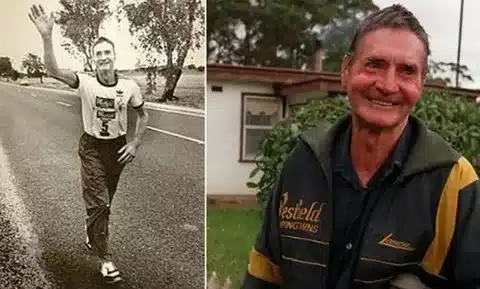
A Most Unlikely Competitor
The inaugural Sydney to Melbourne Ultramarathon was a beast of a race. Stretching over 875 km and expected to last up to seven days. It attracted elite ultramarathoners from around the globe. These were the best of the best: young, muscular, hyper-conditioned athletes armed with advanced gear, professional support teams, and carefully crafted strategies.
When Cliff announced that he would be entering the first Sydney to Melbourne Ultramarathon, most people thought it was a joke untill he showed up in workman’s overalls with holes cut in them for ventilation and a pair of old sneakers that had seen more farm mud than pavement. Cliff shuffled to the starting line looking more like a curious bystander than a participant. His support crew consisted of his brother Sid and a couple of mates. His nutritional plan? A few vegetables, some water, and the occasional cup of tea.
As the race began, the professional runners surged forward with sleek strides and practiced rhythm. Cliff lagged far behind, his gait a slow, loping shuffle that didn’t even look like running. Spectators chuckled. News outlets snapped photos of the old man, who looked wildly out of place. Even his fellow competitors doubted he’d last beyond the first day.
People laughed. Reporters asked if it was a publicity stunt. Spectators muttered that someone ought to stop this poor old man from embarrassing himself.
But Cliff kept moving. He wasn’t fast. He wasn’t flashy. But he was consistent.
It was a philosophy built from a life on the farm. For Cliff, this race wasn’t so different from chasing sheep across vast paddocks. He just needed to keep going. So he did.
By nightfall, Cliff was hours behind the leaders. The pros stopped to rest, adhering to the standard ultramarathon strategy: run for 18 hours, sleep for six.
Cliff didn’t know about that strategy. When he arrived at the overnight stop, the other athletes had gone to bed. On the first night, due to an accidental mis-set alarm by a crew member, Cliff was woken up just two hours after he’d gone to bed. Groggy but determined, he got back on the road. Thinking dawn was near, he resumed running in the dark. By the time he realised the mistake, he had already made up significant ground. He felt good.
That mistake turned out to be a blessing.
By the time the other runners woke up and resumed the race the next morning, Cliff had made up hours of ground. And he just kept going. While the professionals stuck to their schedules, Cliff shuffled on through the night, catching and then surpassing runner after runner.
The media caught wind of what was happening, and soon the entire nation was watching in disbelief. The old man in gumboots was leading the most demanding footrace in Australia.
What truly set Cliff apart wasn’t just his shuffle but his mindset. He simply didn’t know what was “supposed” to be impossible.
Even when exhaustion hit, Cliff Young kept moving. At one point, he tripped over a rock and thought he’d dislocated his shoulder. But he refused to stop. His feet blistered and swollen, his joints aching, he continued forward.
At another point, convinced that the younger professional, Joe Record (with whom he had made a friendly pact to share the prize money if either of them won) was closing in on him, a renewed energy surged through him. In reality, Joe was nowhere close. But Cliff’s imagination drove him forward at a critical moment.
And then, finally, after five days, 15 hours, and four minutes, Cliff Young crossed the finish line in Melbourne.
He had not only won; he’d shattered the race record by nearly two days with no professional training programs and no sleek fitness gear. Just pure grit.
The second-place runner, George Perdon, came in more than 10 hours later. The professional athletes he’d once trailed by hours never even came close.
Legacy of a Legend
Cliff’s victory shocked the world. But what he did next cemented his status as a legend.
The race carried a $10,000 prize for the winner — a hefty sum, especially in 1983. Cliff hadn’t even known about the money when he entered. To him, the race wasn’t about a prize. It was about proving something to himself.
So when he won, he did something even more extraordinary.
When the $10,000 prize money was handed to him, Cliff calmly began giving it away. He handed wads of cash to each of the runners who finished, saying they all deserved to be rewarded for enduring such a punishing journey. He gave most of it away without hesitation. When Joe Record crossed the finish line, Cliff remembered the deal they had made. Though he had little left, he gave Joe the remaining $3,000 and a sincere apology for not saving more.
Cliff didn’t enter the race for fame, money, or glory. He ran because he believed he could. And he gave away his winnings because that’s just who he was.
Cliff Young’s win transformed him into a national icon. He received letters from admirers around the world. Kids dressed up as Cliff for Halloween.
His unique style of running, which was named the “Young Shuffle”, was ridiculed at first. But scientists and coaches would later study it and conclude that it was incredibly energy-efficient. His low-impact gait conserved energy and reduced fatigue, making it ideal for ultramarathon distances.
He went on to run more ultramarathons. None of his later runs matched the media storm of 1983, but they weren’t meant to. Cliff wasn’t trying to relive past glory. He ran because that’s who he was, a man who believed in moving forward, no matter how slowly, no matter how doubted. He never trained in any traditional sense. He never sought the spotlight. But he showed what the human spirit could do when driven not by ego but by quiet determination.
The Lessons
What makes Cliff Young’s story unforgettable isn’t just the victory; it’s the lessons behind it.
His story reminds us that you don’t need to look the part to belong in the race. That expertise doesn’t always trump experience. That sometimes, the most powerful strategy is simplicity. That in a world obsessed with performance, hustle, and polish, humility and heart still have their place. And that sometimes, the people we’re most tempted to dismiss turn out to be our greatest teachers.
He showed us that endurance is not just physical; it’s emotional, mental, and spiritual. That the path to greatness is often walked in solitude. That belief in oneself, even in the face of universal doubt, is a form of quiet rebellion.
Cliff Young didn’t just win a race. He changed how we think about possibility. He reminded us that it’s never too late to chase something extraordinary. That sometimes, life gives the medal not to the fastest, but to the one who refuses to stop moving.
He died in 2003, but his story continues to shuffle its way into hearts around the world, step by determined step.
Stay frosty.




Interesting
Gracias
Nice post. I was checking constantly this blog and I am impressed! Extremely useful info specially the last part 🙂 I care for such information much. I was seeking this particular information for a very long time. Thank you and good luck.
Thank you for stopping by. Do check out other blog posts here. I’m sure you’ll find them interesting.
Everything is very open and very clear explanation of issues. was truly information. Your website is very useful. Thanks for sharing.
Thank you
very nice put up, i certainly love this web site, keep on it
Thank you.