Podcasts were once considered an obscure corner of media, tucked away for enthusiasts who craved long-form conversations outside the noise of mainstream radio and television. They felt exclusive, almost elitist, belonging to people who spoke in measured tones from studios far away in London, New York, or Los Angeles. In Nigeria, podcasts weren’t entirely absent, but they remained on the margins, more observed than participated in, a format that felt distant before slowly finding its footing in local media culture.
Today, that exclusivity is gone. Podcasts are no longer distant or rare; they are everywhere. The format has migrated from niche communities into the mainstream, and in Nigeria it has taken on a life of its own. It is not unusual to stumble across a podcast clip while scrolling through social media, with two people arguing about love, relationships, culture, politics, or money. A single comment pulled from a podcast can dominate the internet for days, sparking outrage, think pieces, and countless memes. What once felt like a special form of content has now become an arena where almost everyone with a microphone has something to say and often, an audience willing to listen.
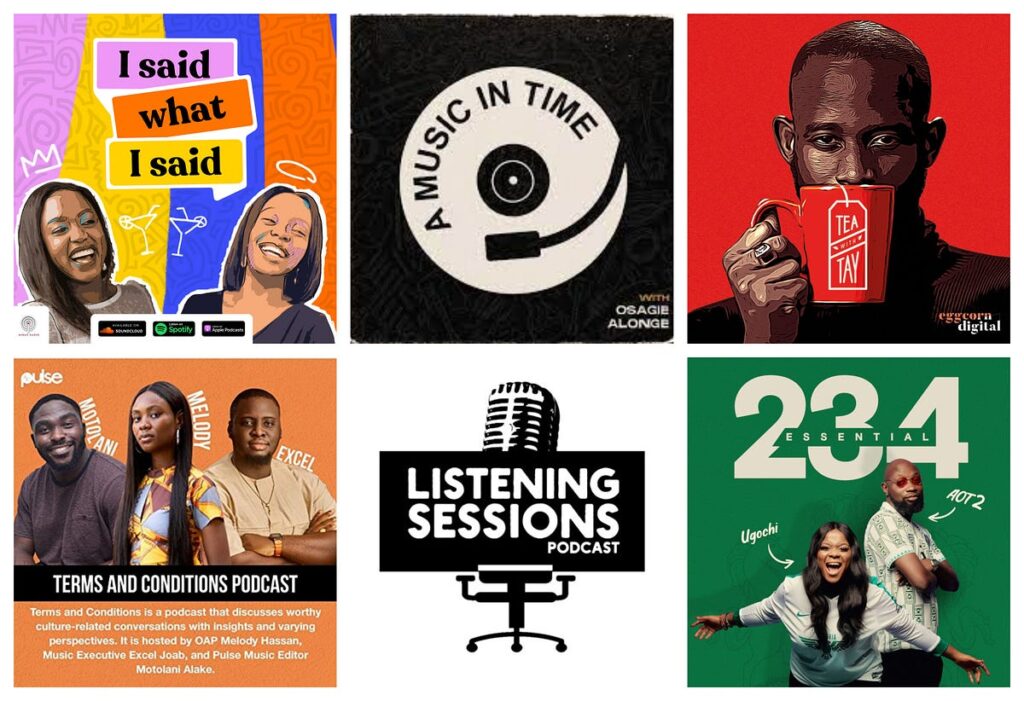
The transformation reflects something bigger: the age of content creation, where barriers to entry are lower than ever. Years ago, producing a show meant access to expensive studios, corporate backing, or media gatekeepers who decided who got to speak. That era has ended. With little more than an affordable microphone, a laptop, and internet access, anyone can now launch a podcast. The accessibility has democratised the space, making it possible for everyday Nigerians, not just celebrities or broadcasters, to join conversations once reserved for radio presenters and newspaper columnists.
This shift has had ripple effects on culture. Nigerians are natural conversationalists; debates and banter are part of the fabric of daily life, whether in traffic, at a bar, or at family gatherings. Podcasts extend this spirit into the digital age, packaging conversations into shareable content. But beyond entertainment, they have become powerful engines for shaping discourse. Some episodes now dominate the news cycle more than press conferences or policy statements.
A bold statement on relationships can cause an online gender war for days. A guest exposing workplace drama might lead to public outcry and even contract terminations. Friendships and collaborations have collapsed because of things said on air. In some cases, celebrities have had to issue public apologies for careless comments that went viral through podcast clips. Nigerians even joke about it now, saying “last last na podcast go divide this country,” whenever a clip ignites a fresh round of online battles.
The phrase is funny, but it captures the weight podcasts now carry in the nation’s digital life.
This is where the double-edged sword of podcasting comes alive: on one hand, it democratises conversations, but on the other, it can ignite chaos in ways that can’t be contained once the clip hits social media.
It’s easy to see why. Podcasts thrive on honesty, or at least, the performance of honesty. The appeal lies in people saying things that feel raw, unfiltered, and spontaneous. When a host or guest opens up about personal experiences, sensitive cultural issues, or bold political takes, it feels intimate. Listeners are drawn in, almost like eavesdropping on a private gist. But the very intimacy that makes podcasts engaging also makes them dangerous. Words that feel casual in the heat of a conversation are immortalised once uploaded. A flippant joke can be replayed thousands of times, stripped of context, and used as evidence in the court of public opinion.
Still, focusing only on the controversies would diminish the larger story. The rise of podcasts has broadened access to voices and ideas that once had no platform. They have allowed Nigerians from all walks of life: comedians, entrepreneurs, activists, writers, or simply curious minds, to share perspectives with audiences both local and global. Conversations about mental health, gender, identity, creative struggles, and politics now have a home in a format that does not rush them or strip them down for soundbites.
For a generation of young Nigerians who often feel misrepresented or unheard in mainstream media, this matters deeply. Podcasts give them space to listen to themselves and to see their experiences reflected back in conversations that feel genuine.
There is also the cultural shift they represent. For years, traditional media in Nigeria operated within tight boundaries; they were regulated, cautious, and often repetitive. Podcasts broke that mould. They do not require government licensing or the blessing of broadcasting corporations. They are messy, loud, opinionated, and, at their best, brilliantly original. They embody a kind of freedom that traditional media has never been able to offer, and in that sense, they mark an important turning point in Nigeria’s media history.
Nonetheless, every boom comes with excess. The sheer number of podcasts today makes it difficult to separate the meaningful from the mediocre. Not all shows are well thought out, and not every host has something substantial to say. Some are poorly produced, with weak audio and recycled content. Others are driven not by the desire to inform or entertain but by the pursuit of virality, deliberately stirring controversy to attract attention. This saturation has created a noisy environment, where sensitive conversations risk being trivialised, reduced to viral clips and memes and and stripped of the depth they deserve.
There’s also the issue of echo chambers. Because podcasts often cater to niche audiences, they can become bubbles where the same ideas circulate without challenge, reinforcing stereotypes instead of breaking them.
Yet, despite all this, it would be unfair to dismiss the phenomenon as just another fleeting internet craze. What we are witnessing is the reshaping of media in real time. The rise of podcasts in Nigeria signals our hunger for unfiltered dialogue, our love of storytelling, and our willingness to embrace messy, complex, and sometimes uncomfortable conversations that don’t fit into the boxes of traditional media. It also signals a shift in power from large media corporations to everyday individuals.
The Future of Podcasts
The challenge now is how both creators and audiences navigate this space. For podcasters, the task is to balance honesty with responsibility, entertainment with depth, and accessibility with quality. For audiences, it is to listen with discernment, to seek out substance amid the noise, and to hold creators accountable without demanding silence.
The future of Nigerian podcasts won’t be defined by the loudest viral clips but by the creators who can consistently build trust, add value, and spark conversations that outlast the trends. Many of the podcasts that sprang up in the heat of the trend may not survive the next few years. Some will fade as quickly as they arrived, while a few will mature, carve out loyal audiences, and establish themselves as cultural institutions.
In a sense, podcasts are a mirror of our society. They capture both the brilliance and the recklessness of our current era: the urge to speak freely, the eagerness to be heard, the risks of carelessness, and the beauty of connection. Nigeria has embraced this medium with characteristic energy, turning it into something vibrant, chaotic, and uniquely its own. Whether for better or worse, the podcast boom has ensured that more voices than ever are part of the conversation. It has changed not just what we listen to, but how we engage with each other.
So, yes, the era of podcasts is here, and in Nigeria, it is loud, unfiltered, and here to stay.
Stay frosty.



Amazing
🙏🙏🙏