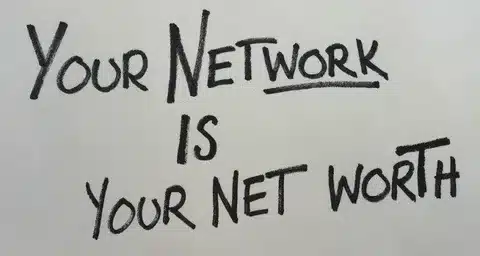
A network is not just a list of contacts. It’s an ecosystem. Nobody, and I mean nobody, gets to where they want to be entirely on their own. We all need a crew. We need people who can open doors, people who can fix our mistakes, and people who will tell us when we have spinach in our teeth (metaphorically and literally).
If you want your career and your life to feel supported, you don’t just need contacts; you need a diverse mix of humans who bring different energies to the table.
Here are the eight types of people you should have in your corner.
References:
These are the people who can vouch for your competence, your reliability, and your character when you’re not in the room to do it yourself. Their value isn’t in how often you speak but in how confidently they can say, “I trust this person’s work.”
Think of your references as your professional safety net. When you’re up for a big promotion or a new gig, these folks are your character witnesses. You want people here who don’t just remember your job title but who remember your work ethic and how you handled things when the pressure was on.
A common mistake is treating references as a last-minute requirement, something you scramble to assemble when an opportunity appears. In reality, they’re a long-term asset, built through consistent interactions.
Don’t let these relationships get dusty. Reach out once in a while just to see how they are doing, not just when you need a favour.
Coworkers and Conference Buddies:
These are your “in the trenches” people. Whether it’s the colleague in the same office, a former teammate you still check in with, or the person you end up grabbing a drink with every year at the same industry conference, they understand the texture of your day-to-day work. The language, the pressure points, and the internal dynamics no one writes about but everyone deals with. And that understanding makes the relationship practical.
But there’s another layer to this that’s easy to miss. Over time, trajectories start to separate.
The person you once shared notes with after a workshop moves into leadership. Someone else pivots into a different market. Another builds something of their own. And almost without you noticing, the people who once felt like they were on the exact same path as you start opening doors into spaces you haven’t stepped into yet. Having a solid group of coworkers, past and present, creates a bridge between companies.
That’s what makes these relationships valuable. Not just where they sit today, but where they’re headed and the shared history that makes the connection hold.
Advisors, Mentors, and Sponsors:
These three are often grouped together, but their roles are distinct, and understanding that distinction changes how you engage with them.
Mentors help you make sense of your path. They draw from experience, offering perspective that shortens your learning curve.
Advisors step in more selectively. You go to them when you need clarity on a decision, a strategy, or a specific challenge. Their value is precision.
Sponsors operate differently. They don’t just guide, they intervene. They advocate for you in spaces where decisions are being made. They attach your name to opportunities.
The mistake many people make is focusing heavily on mentorship while overlooking sponsorship. Guidance is important, but advocacy often determines access.
None of these relationships are built through formal requests alone. They emerge when people can see your thinking, your work ethic, and your potential and decide, on their own, that you’re worth backing.
You need all three. You need the wisdom of a mentor, the strategy of an advisor, and the muscle of a sponsor.
Industry and Functional Experts:
Every field has its trends, opinions, and constant updates. Industry and functional experts cut through that. They have spent years understanding the mechanics of their craft, which means they can distinguish between what’s fundamental and what’s fleeting.
Being connected to them doesn’t mean constant interaction. Often, it’s about proximity: learning from how they think, how they approach problems, how they explain complexity. This is where your own thinking sharpens.
You start asking better questions. You stop chasing every new idea and focus on what actually moves the needle. You develop a sense of judgement that is hard to teach but easy to absorb when you’re around the right people.
The key here is approach. Experts don’t respond well to vague outreach or performative admiration. They respond to curiosity that’s grounded in effort.
When you engage, bring something to the table: an insight, a question that shows depth, or a perspective worth exchanging.
Friends:
Not every relationship in your network should be optimised for career growth. Some should exist simply to keep you balanced.
Friends provide that counterweight. They exist outside the logic of career progression. They see you beyond titles and roles, beyond achievements, beyond whatever phase you’re currently navigating. And that perspective matters more than most people realise.
Without it, it’s easy to become overly absorbed in metrics: KPIs, salaries, deliverables and quarterly goals.
Friends interrupt that pattern. They offer context. They remind you of who you are when you’re not performing. They are the ones who make sure you actually take a vacation and remind you that there is a whole world outside of your office walls.
They also provide honesty that isn’t filtered through professional considerations. That honesty can be grounding, especially when everything else feels uncertain.
A network that only advances you, without stabilising you, is incomplete. Never underestimate the power of a friend who knows little or nothing about your job.
Alumni:
Shared affiliation is one of the fastest ways to reduce friction in a relationship. Be it a university, a past workplace, or a professional programme, alumni connections come with built-in context. There’s a baseline understanding that makes conversations easier to start and sustain.
That ease translates into opportunity. Information circulates more freely in these spaces. Introductions happen with less resistance. There’s an underlying willingness to engage, simply because of that shared background.
Yet many people underutilise this. They treat alumni networks as something to revisit only when actively searching for a job. In reality, they function better as ongoing communities.
Staying engaged doesn’t require constant interaction. It requires consistency. Occasional check-ins. Genuine interest in what others are doing. Participation when it makes sense.
Over time, those small interactions compound, turning a loose affiliation into a meaningful network.
Recruiters:
A lot of people only talk to recruiters when they are desperate for a job. That is a mistake.
You want to have a handful of recruiters in your network while you are perfectly happy where you are. Why? Because they have their fingers on the pulse of the market. They know what salaries look like, which companies are secretly falling apart, and which ones are about to explode with growth.
They see patterns across industries. They know which skills are in demand, how roles are evolving, and where opportunities are emerging before they become widely visible.
Building a relationship with a recruiter gives you access to that perspective. But it only works if the relationship is treated as a relationship.
Clear communication matters. So does consistency. If your interests change, say so. If your availability shifts, update them. If you commit to something, follow through.
And importantly, don’t limit the interaction to moments of urgency. Staying in touch over time makes it easier for them to place you when the right opportunity appears.
Think of recruiters as your scouts. Even if you aren’t looking to move right now, knowing what’s out there helps you understand your own value.
Social Media Connections:
It’s no longer necessary to share physical spaces to build meaningful connections. Ideas, perspectives, and conversations travel across platforms, creating points of contact that didn’t exist before.
Engaging thoughtfully through commentary, sharing insights, or contributing to discussions builds recognition. Not the superficial kind, but the kind rooted in how you think and communicate. Over time, that recognition compounds.
People begin to associate your name with a certain perspective. They remember your contributions. They reach out, respond, and include you in conversations. And from there, the line between “online” and “offline” connections starts to blur. Collaborations emerge. Opportunities surface. Relationships take shape.
How to Maintain Your Network
Now that you know who you need, how do you keep these relationships alive without it feeling like a second full-time job?
It’s simpler than you think:
The “Thinking of You” Text: If you see an article that reminds you of a former coworker, send it to them. No strings attached.
The Birthday/Promotion Shout-out: Use those social media notifications for good. A quick “Congrats, you earned it!” goes a long way.
The Help-First Mentality: Always look for ways to help others before you ask for anything. If you see someone in your network looking for a graphic designer and you know a great one, make the intro.
Be Human: You don’t have to be a ‘professional’ robot. Be yourself. People remember how you made them feel much more than they remember what was on your resume.
Your network is a living, breathing thing. It’s a group of people who make your life richer, your career smoother, and your bad days a little more bearable.
As you build these connections, remember, it’s not one-sided. At different points, you’ll be these people for someone else. So don’t just look for value, be it. Be reliable. Share opportunities. Speak well of others. Show up with intention.
The kind of network you want is built by the kind of person you choose to be within it.
Stay frosty.