AFCON 2025, which spilt into 2026 and was hosted in Morocco, was more than an electrifying football tournament. It became a cultural moment, a political flashpoint, and an unexpected history lesson rolled into ninety minutes of football and a single controversial celebration.
Among the many matches, goals, heartbreaks, and triumphs, one moment stood taller than the rest. It happened during the tense encounter between Algeria and DR Congo. DR Congo were trailing, the pressure was heavy, and emotions were already running high when an Algerian player scored and chose to celebrate in a way that instantly lit a fire across social media and beyond.
After finding the back of the net, the Algerian forward, Mohamed Amine Amoura, struck a pose. He stood still, upright, with arms positioned in deliberate imitation, then dramatically fell to the ground as though a statue had been knocked over. What might have seemed like just another taunt in football culture carried far more weight than he likely imagined.
The pose was a direct mockery of DR Congo’s iconic super fan, Michel Nkuka Mboladinga. Mboladinga is famous across Congolese football culture for standing on an elevated platform during matches, striking the same pose every time DR Congo plays. His stance mirrors that of one of the most powerful statues in Kinshasa, that of Patrice Lumumba, the country’s first prime minister and one of Africa’s most enduring symbols of resistance.
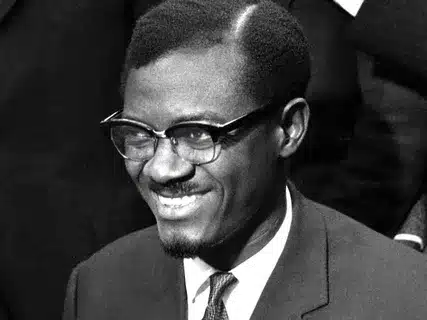
To many Congolese fans, the fall to the ground was not just banter. It looked like the symbolic toppling of Patrice Lumumba himself. That single act opened a floodgate of reactions, arguments, explanations, jokes, anger, education, and reflection. Conversations spread across timelines, group chats, podcasts, sports shows, and living rooms. Patrice Lumumba’s name trended far beyond Central Africa.
For countless people around the world, this moment marked the first time they ever heard the name Patrice Lumumba. A football celebration had resurrected a history that colonial powers once tried desperately to erase.
Patrice Lumumba was born on July 2, 1925, in the Kasai region of what was then the Belgian Congo. He grew up under a colonial system designed to extract wealth while denying dignity. Education for Congolese people was limited and carefully controlled. Advancement was permitted only to the extent that it served colonial interests.
Lumumba, however, stood out early. He was intelligent, articulate, and deeply curious. He read widely, questioned authority, and developed a sharp understanding of how colonialism functioned. By the time he entered public life, he was already convinced of one thing: Congo’s vast wealth belonged to Congolese people, not foreign companies or European governments.
When Lumumba stepped into national leadership in 1960, he was just 34 years old. Youth did not dilute his conviction. His politics were rooted in dignity, economic independence, and African self-determination. He did not believe independence should be symbolic or decorative. Freedom, to Lumumba, meant control over land, minerals, labour, and destiny.
This belief placed him on a collision course with Belgium, the colonial power that had ruled Congo with brutal efficiency for decades. Belgium’s interest in Congo was never hidden. The country sat on enormous reserves of copper, cobalt, uranium, diamonds, and gold. Independence threatened a system that had enriched foreign corporations and governments for generations.
Lumumba was not interested in managing colonial expectations or softening his message to appear agreeable. He spoke plainly. He spoke fiercely. He spoke as though Congo already belonged to its people.
In 1956, Belgian authorities arrested Lumumba on charges of embezzlement. On paper, it was a financial crime, but in reality, it was a convenient method to silence a man who had become too vocal, too influential, and too dangerous to colonial control. He spent one year in prison. The experience did not weaken him. It sharpened him.
After his release, Lumumba emerged even more radical in his beliefs. His speeches grew bolder. His following grew wider. In 1958, he founded the Mouvement National Congolais (MNC), a political party built on national unity rather than ethnic division. That alone made him a threat in a system that relied heavily on fragmentation.
By 1959, Lumumba’s popularity had become impossible to ignore. Anti-colonial protests erupted across Congo. Belgian authorities blamed him for the unrest and arrested him again. This time, he was sentenced to six months in prison. He was released in early 1960, just months before independence, due to mounting pressure and the impossibility of excluding him from Congo’s political future.
The elections of 1960 confirmed what many already knew. The MNC emerged victorious. Days before independence, Patrice Lumumba became the first prime minister of the Democratic Republic of Congo.
On June 30, 1960, Congo officially became independent.
The ceremony should have been a moment of pride and healing. Instead, it became one of the most powerful confrontations in modern African history. King Baudouin of Belgium delivered a speech praising Belgium for bringing civilisation, order, and progress to Congo. His words reflected a colonial fantasy that erased violence, exploitation, and suffering.
Lumumba was not scheduled to speak, but he stood up anyway. His speech shattered the illusion. Congo’s independence, he said, was not a gift. It was taken after years of forced labour, humiliation, racism, and bloodshed. He spoke of whips, insults, stolen land, and stolen futures. He spoke of resistance. He spoke of dignity reclaimed.
Africa listened. Europe panicked.
Almost immediately, Congo was thrown into chaos. Soldiers in the Congolese army mutinied against their European commanders. Belgium sent troops back into Congo without permission, claiming to protect its citizens. Katanga, the richest province in the country, announced its secession with Belgium’s backing. The goal was simple: protect mining interests and weaken Lumumba’s control.
Lumumba turned to the United Nations for help. Peacekeepers arrived, but they refused to assist in stopping Katanga’s breakaway. Faced with isolation, Lumumba made a decision that would seal his fate. He sought assistance from the Soviet Union.
This was the height of the Cold War. To the United States, Lumumba suddenly looked like a communist threat. To Belgium, he remained uncontrollable and disastrous for business. To his enemies within Congo, he had become vulnerable.
President Joseph Kasa-Vubu dismissed Lumumba from office. Lumumba declared the move illegal. Parliament supported him. The standoff paralysed the government, and power was seized in a military coup.
The army chief, Joseph-Désiré Mobutu, later known as Mobutu Sese Seko, placed Lumumba under house arrest. When he attempted to escape to the eastern part of the country to reach his supporters, he was captured by soldiers loyal to Mobutu.
What followed was cruelty designed to humiliate. Lumumba was beaten, paraded, mocked, and detained. He was forced to swallow a written speech he had prepared, a symbolic attempt to silence his voice permanently.
He was flown to Katanga, the very region controlled by his enemies. On January 17, 1961, Patrice Lumumba was executed by a firing squad alongside two of his closest allies. He was 35 years old.
They were buried in a shallow grave. Even death was not enough for his killers. Belgian officers involved in the operation later returned, exhumed the bodies, and dissolved them in acid. Their mission was total erasure, but fate had other plans.
Decades later, a single piece of Lumumba was returned to his family: a gold-capped tooth recovered from the belongings of a former Belgian police officer.
Belgium eventually admitted moral responsibility for his murder. Declassified documents revealed that the United States supported his removal from power.
After Lumumba’s death, the country slid into years of dictatorship, foreign exploitation, and systemic corruption. Mobutu ruled for decades. Resources continued to leave Congo while its people remained trapped in poverty. The future Lumumba warned against became reality. Congo paid the price. This is why the pose mattered.
Following the AFCON incident, the Algerian Football Federation issued an apology to DR Congo. Mohamed also apologised, stating that he did not understand the significance of the gesture and did not intend to mock an entire country or its history.
That explanation resonated with many people, myself included. Patrice Lumumba’s story is not widely known outside specific regions. For many, this moment was the first introduction to his life, his ideals, and his brutal end.
A simple gesture reopened long-buried history and carried it across borders. Football became the vehicle. Memory became the destination. The story did not end there.
When Nigeria later faced Algeria, Super Eagles forward Akor Adams scored the second goal that saw Algeria exit the tournament. His celebration said everything. Adams struck the Lumumba pose, standing tall in honour of the legend and the Congolese super fan who kept that memory alive.
Online banter exploded instantly. The irony was impossible to miss. What began as Algeria’s moment of mockery circled back across the internet and, symbolically, landed in Congo’s favour. By the end of it all, it felt as though the victory Algeria once claimed had changed sides.
History has a way of resurfacing when least expected. Patrice Lumumba remains standing as proof that some stories will never disappear. Decades after his death, he found a way to return, unapologetically, on one of Africa’s biggest stages; AFCON 2025/2026.
Long after the final whistle, his name lingered in conversations far beyond football. Senegal eventually lifted the trophy, Morocco, the host country, finished second, and Nigeria claimed third place, but for many, the tournament will always be remembered for how history unexpectedly stepped back onto the pitch.
Stay frosty.