Skin bleaching in Nigeria refuses to fade into history. You think it has been discussed enough, explained enough, and warned about enough, yet it keeps returning in new forms. It keeps resurfacing in conversations everywhere: markets, family compounds, salons and social media timelines. The puzzling part is not just that it exists but how normal it has become.
Creams are discussed like groceries. Injections are recommended in excitement. Results are inspected the way you would inspect new phones. I find myself wondering why this desire refuses to loosen its grip, even when the risks are common knowledge and the outcomes often look painful rather than beautiful.
This is not coming from a place of scolding or moral superiority. It feels more like standing in front of a mirror and asking questions out loud.
Nigeria is not lacking in natural beauty or diversity of skin tones, from light honey tones to deep browns, all of them complete in their own right. Still, the belief persists that lighter is better.
In addition, Nigerians are not even among the darkest-skinned people on the continent, yet the chase for lighter skin keeps intensifying. What is striking is that even people who are already naturally fair-skinned still bleach, as though fairness itself is a moving target that can never be reached.
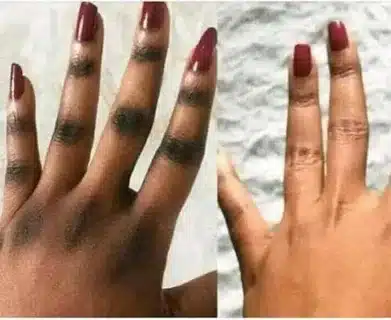
Once you start paying attention, the physical effects are hard to ignore. Faces lose their softness. Skin becomes shiny in an unnatural way, stretched thin and uneven. Knuckles darken sharply; elbows and knees refuse to cooperate with the rest of the body. The image that often comes to mind is roasted ripe plantain, unevenly cooked, dark in some places, yellow in others, dry in patches but clearly burnt by too much heat. This is not a rare sight anymore. It has become familiar enough that people barely pause to stare.
That familiarity is unsettling. When damage becomes normal, it stops triggering concern. It simply blends into everyday life. The question then shifts from why people bleach to why we have collectively accepted what bleaching does to the body.
The discomfort deepens when children enter the picture. Skin bleaching has spread so widely that some parents now bleach their children. Babies and toddlers are rubbed with creams meant to alter their skin tone long before they can speak for themselves. There is no justification for this. Even before a child understands the world, they are being taught that their natural skin is somehow inadequate, that what nature gave them is not enough.
That idea settles early, and by the time the child grows up, the belief feels like common sense rather than something that can be questioned.
A walk through Nigerian markets tells another part of the story. Beauty shops overflow with soaps, creams, oils and serums promising brightness, glow, whitening or tone correction. Some products are blunt about their purpose. Others hide behind softer language that sounds harmless. The shelves are so crowded with aggressive formulas that finding something genuinely neutral is a lot of hard work.
What makes this more complicated is how easy it is to bleach accidentally. Many people who insist they would never bleach still end up lightening their skin without meaning to. Ingredient lists are rarely understood, and names like ‘hydroquinone’ or ‘potent steroids’ mean little to the average buyer. Someone buys a cream for dryness, stretch marks or acne, only to notice weeks later that their skin tone has shifted. Bewildered, the user drops the product, but sometimes the changes remain.
This flood of bleaching products has shaped the market so thoroughly that avoidance now requires education. Even then, mistakes are common. The demand has become so strong that it affects everyone, including those who simply want to maintain their natural skin.
The question that keeps looping back is why fair skin is still treated like an advantage. Why it carries assumptions of desirability, softness or success, while darker skin is expected to prove itself. Many people describe this as a colonial mindset, a way of thinking inherited rather than chosen, where bodies were ranked by shade and value was quietly assigned along that scale. That explanation does not cover everything, but it lingers, partly because its effects are still visible in who is praised, who is believed and who is seen as acceptable by default.
Generations grew up watching lighter skin open doors more easily. The media reinforced it. Advertising polished it. Compliments upheld it. Over time, the idea settled into everyday thinking. Fairness became shorthand for progress, even when reality offered no guarantees.
Medical warnings on this menace have not been subtle. Healthcare professionals warn about weakened skin, infections, kidney problems, skin cancers, contact dermatitis, foetal damage in pregnant women, steroid acne and other forms of long-term damage. These are not rumours. They are documented outcomes. Awareness campaigns exist. Information is available and widely accessible. Yet the creams continue to sell in huge quantities.
Public validation might arrive faster than health consequences. Compliments come before complications. A lighter face attracts praise long before the body begins to protest. By the time damage becomes obvious, stopping is complicated. Some people continue bleaching simply to keep their skin tone even, trapped by choices made earlier.
Bleaching often begins with comparison rather than curiosity. Someone else looks lighter. Someone else is praised more. Someone else seems more desirable. Gradually, the body becomes a project that must keep up. Individual taste dissolves into shared expectations.
Regret exists, even if it stays mostly hidden. Many people who bleach carry their disappointment and damage silently. When the excitement fades and maintenance becomes expensive, the skin reacts unpredictably. Compliments turn into stares. Some wish they had never started, but a few of those stories make it into the spotlight.
Choosing not to bleach in Nigeria now feels like an intentional act rather than a default setting. It means reading labels, asking questions and sometimes pushing back against comments from friends or family. It means accepting one’s reflection without trying to edit it into something more socially approved.
Skin bleaching in Nigeria is not a simple issue with a neat conclusion. It grows out of aspiration and social conditioning, pressures that influence self-esteem. The fact that it has become so widespread, even extending to children, suggests that it is more than vanity.
I keep returning to the same questions. What would it take for dark skin to feel sufficient without explanation? What would happen if health mattered more than a fairer skin?
These are not conclusions. They are thoughts worth sitting with, especially in a society still negotiating its relationship with skin, beauty and self-worth. History suggests that even with stricter measures to limit bleaching products, the demand for them will continue to encourage production and circulation. A sobering reality.
Stay frosty.